Manually writing static type interfaces for complex, deeply nested JSON payloads from third-party APIs is tedious and error-prone. OmniTool Hub's JSON-to-Code Interface Converter recursively inspects any sample JSON payload, infers primitive types and optional keys, and synthesizes type-safe interface definitions for TypeScript, Python Pydantic, Go, and Rust.
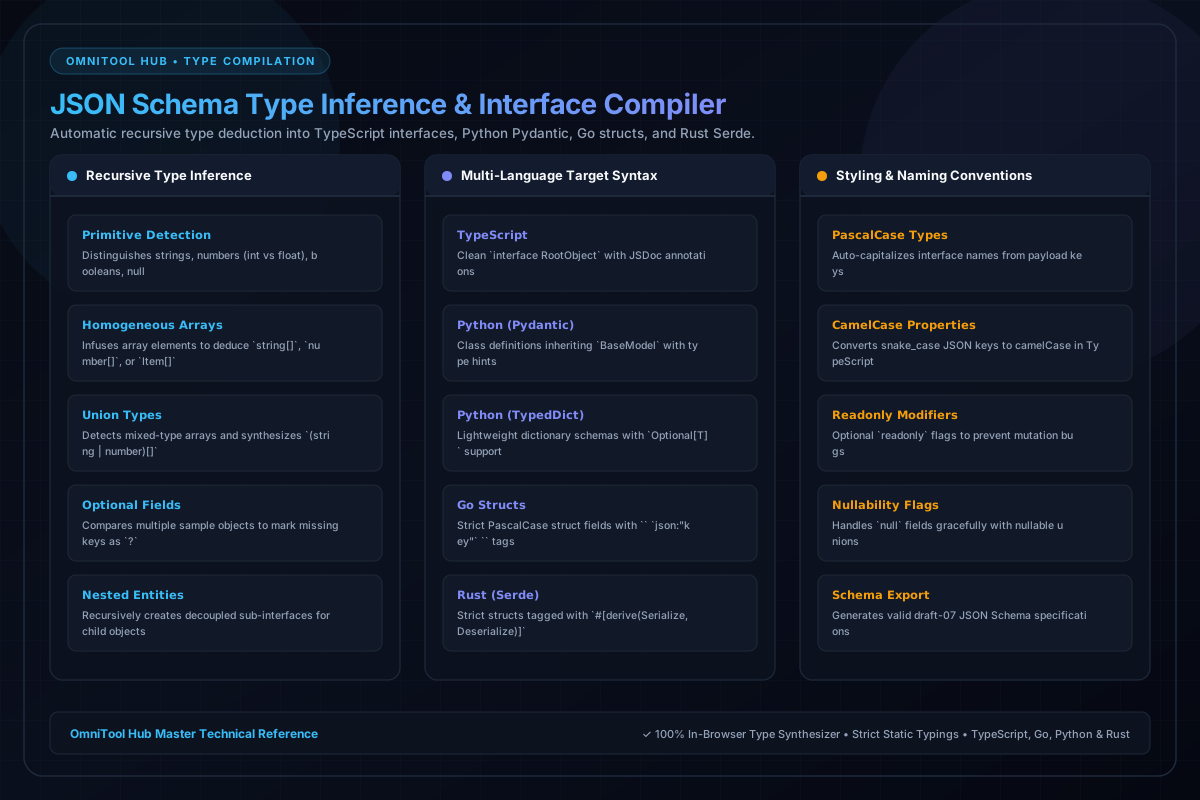
Supported Target Type Systems
Here is a detailed breakdown of the capabilities, algorithms, and configurations available within this tool suite:
Generates clean `export interface` blocks with optional property `?` markers, union arrays, and nested sub-interfaces.
Creates modern Pydantic v2 `BaseModel` classes with `Optional[T]` typing and field type hints for FastAPI backends.
Produces idiomatic PascalCase Go structs annotated with `` `json:"field_name"` `` tags for standard `encoding/json` parsing.
Generates strict Rust structs decorated with `#[derive(Serialize, Deserialize)]` and snake_case serde renames.
Step-by-Step Usage Guide
- Paste your sample JSON payload into the input editor.
- Select your target language: **TypeScript**, **Python Pydantic**, **Go**, or **Rust**.
- Configure naming preferences (root interface name, PascalCase vs camelCase).
- Inspect the generated type definitions in the output panel.
- Click **Copy Code** to paste directly into your frontend or backend codebase.